
“Torn”
At Drawing Rooms, forty-four artists gather to rip it up.

A crumpled-up piece of paper and a mangled sheet of metal have certain visual similarities. In both cases, rough circumstances have given strange new facets to machine-flattened material. That which was once uniform and controlled has been shot through with irregularity. It feels like a metaphor for life. A curator could put both pieces behind a vitrine and call that an exhibition.
She’d likely be wrong to do that, though. Not all distressed objects say the same thing. Metal doesn’t tend to bend or tear without the application of extreme forces: an accident, a collision, rude treatment by Mother Nature. Paper, by contrast, rips in human hands. One alteration suggests damage that is done to us. The other suggests damage we do ourselves.
There are hard-edged pieces in “Torn,” a forty-four artist group show that’ll hang at Drawing Rooms (926 Newark Ave.) until October 11. Consider, for instance, Joseph Marchesi’s “Darkness Is a Title,” a haunted little dream of a half-remembered interior rendered in oil paint on weatherbeaten and splintered wooden panels. But most of the works in this sharp-elbowed, sophisticated, thoughtful exhibition are fashioned from the stuff over which our fingers have dominion. If an art show is a kind of performance, “Torn” is a prestidigitation act, full of things stripped, and snipped, and shredded, and peeled, and then spliced and knotted back together at peculiar angles. The tactile thrill of tearing sheets in half is palpable in the gallery.

Much of the pleasure of “Torn” is optical: these are artists who know how to tickle the retina with interesting shapes, tones, and strict visual rhythms. If they’re going to put a hole in a sheet of paper, they’re going to make sure it’s where it needs to be in order to maximize tension and intrigue. That means command over negative space as well as control over the mark. When the media is mixed in mixed-media pieces, nothing goes into the Mixmaster without spending time in the measuring cup first.
This includes a winsome, stormy assemblage by Dorit Shmuel, who knows right where to let her materials pucker, where to smear red paint, and where to pull back to let her azure pigment shine. It also includes the fractured lines and accidental sigils of James Kozlik’s work, Susan Reedy’s masticated and reconstituted red-white-and-blue advertisement, Brad Terhune’s carefully considered collages with each element chosen for the resonance it makes, and Laura Lou Levy’s emotional yet methodical charcoal drawing “How Is Your Sister?,” all stitched up with metallic thread and dotted with golden magic marker.
Gallerist and curator Anne Trauben — no stranger to tearing, fraying, and cutting — continues to excel at placement and juxtaposition. Her smart presentation keeps these works talking to each other, and reinforces the feeling that you’re walking into a web of associations. Grids, literal and implied, are everywhere. Shoshana Pofelis’s warm weave of pink, brown, and white strips in a pattern that evokes the back of a beach chair. Stacy Bogdonoff’s furious thatch of stitching in “Split Level” is reminiscent of a tenement window box in the center of a sheet of graph paper. No matter how ragged and ripped its edges are, this show feels scrupulously plotted.

Even when these artists are busy representing chaos, their pieces can feel as tweezered as a plate at a Michelin-starred restaurant. One of the show’s most startling contributions is also among its smallest and, superficially, most unassuming: a framed eight-by-eight inch assortment of thin paper arcs and chips of acrylic paint called “9.11.2001 — 11,893.” Charlotte Gould’s piece resembles a sinister burst of confetti. The sickle-sharp ends of the paper and paint strips suggest verticality and the feeling of falling. Is this meant to be an image of a tower in mid-collapse, or is it just an approximation of the energies unleashed by tragedy? Does it matter?

Similar entropic energies crackle from “Torn Cityscape,” a giclée print by Elizabeth Finger. A quartet of overlapping glass skyscraper façades are surrounded by broken shapes, including a rough square, a trapezoid, and a rectangle coming apart. Finger has tipped these geometric figures to give her landscape an uncommon (and unnatural) feeling of motion. The whole town may be on the move, weightless, wadded up, and rolling to the right.
The key to the effects generated by these pieces is precision. These artists understand spatial relations, and the uncanny way that their diagonal lines interact, and finding the exact slot in the frame that sets the drama in motion. If Finger or Gould had slid the elements of their pieces a millimeter or two in the wrong direction, their images wouldn’t create the shudder in the mind that they do. They demand steadiness of hand and clarity of vision. In “The Sea I See,” Jenna Lynch works by accretion, layering one piece of torn paper atop the next, leaving a fingernail’s width between sheets, building steadily and inexorably, pulling like the moon on the tide, summoning the wave.
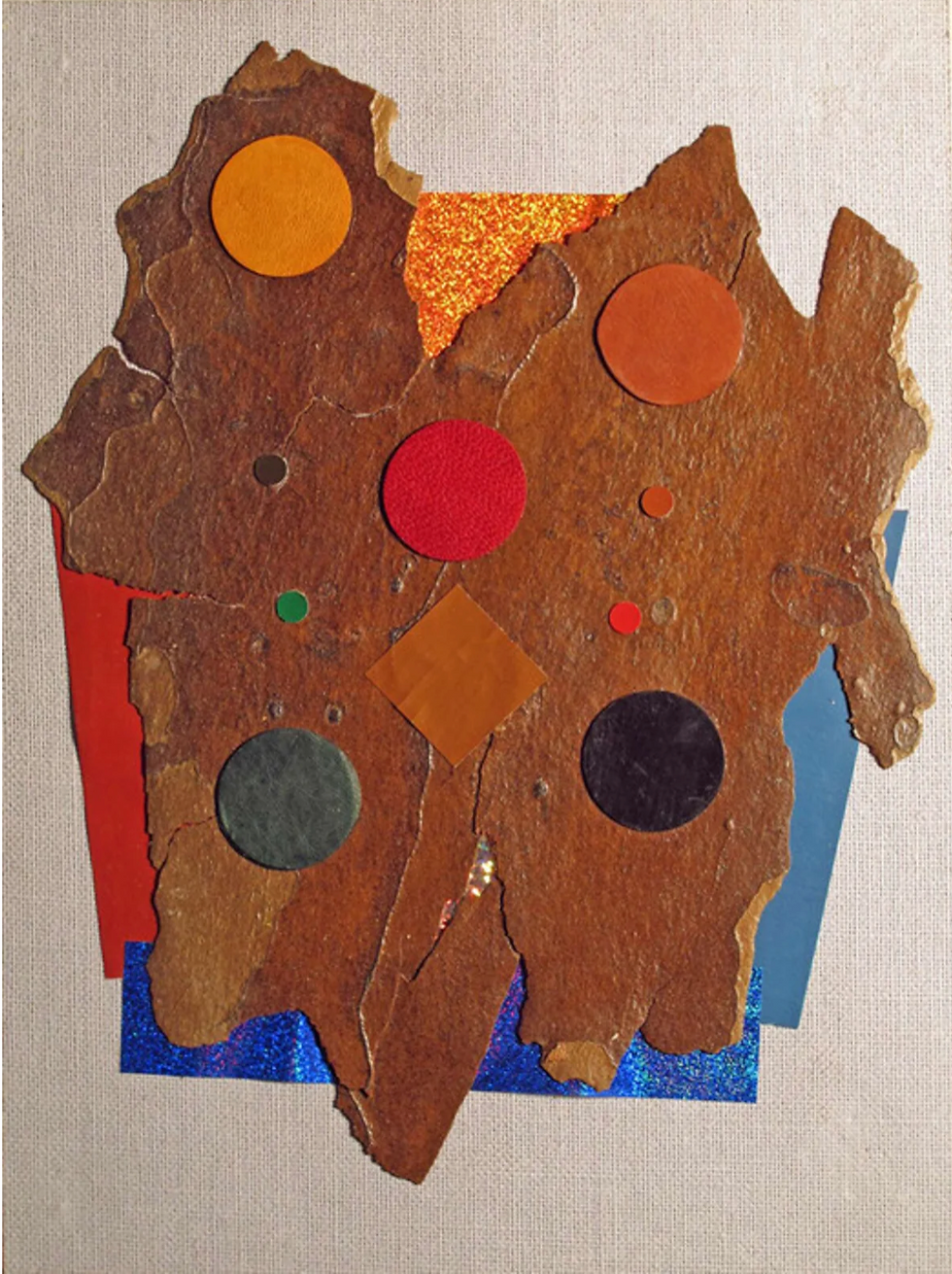
Delicate materials amplify this dynamic. An artist who can rough up gentle organic surfaces and still get them to sing has demonstrated provisional mastery of the natural world. Bob Rivek’s “Bark Mask” has been peeled off of a tree and decorated with colored circles and diamonds. How he managed to smooth the bark — and get it to take on the aged, warm character of a leather watchband — is a secret best left to the forest spirits. Earthier still is Melissa Harshman’s elfin “Rip Torn II,” a pair of thin brown and beige paper sheets, one laid atop the other, filled with hundreds of Swiss cheese apertures. It looks like bubbles effervescing through a mahogany panel. The free-hanging piece is a little marvel, and a thoroughly successful execution of an unusual idea.
But nothing in this show rises from the frame with the same ghostly significance as Joanne Park’s “Archetype I,” a frightening visitation in yellow, black, and gray. Technically, this is an abstract piece made from inverted paint drippings and lateral smears of acrylic across a broad canvas. But the superimposition of a warped wire mesh atop the work transforms it into a blasted landscapes. The undulations in the metal resemble wisps of smoke. A few even rise above the top of the canvas. The whole thing seems to be smoldering, and the upside-down black drippings take on the forlorn look of flame-struck fortresses.

Drawing Rooms isn’t a sprawling gallery complex, but it’s cleverly subdivided into a few exhibition spaces. The art in these side galleries isn’t technically part of “Torn,” but it may as well be: pieces hung there share many of the virtues of the works in the group show, including thoroughness, control, and the sense of completion and satisfaction that comes from an experiment that has gone well. Paul Santoleri coats the walls of a small space with an efflorescent of curls and fronds. It’s floor to ceiling overgrowth in black and white, and it’s pleasantly overwhelming to be welcomed to his jungle.
Out in the Alcove Gallery, a trio of artists generate their own tangles. Ellen Martin scratches bows and swirls into her paintings. Richie Vicensio covers his horizontal panels with scores of parallel lines; sometimes it looks topographical, and sometimes it’s like a particularly meticulous electrocardiogram. Best of all is Madison Rocap, whose “Whispers of the Supernova” is a play of aerosol, watercolor, and drawn lines, everything in the piece whirling and encircling, cresting and gathering strength, but never losing its balance or composition. At a glance, it looks like a piece that’s about to spin out of control. Not this September.
(Drawing Rooms is open on Thursdays and Fridays from 4 p.m. until 7 p.m. and Saturdays and Sundays from 2 p.m. until 6 p.m. They’ll host a twenty-fifth anniversary celebration on Saturday, September 19 at 6 p.m.)


