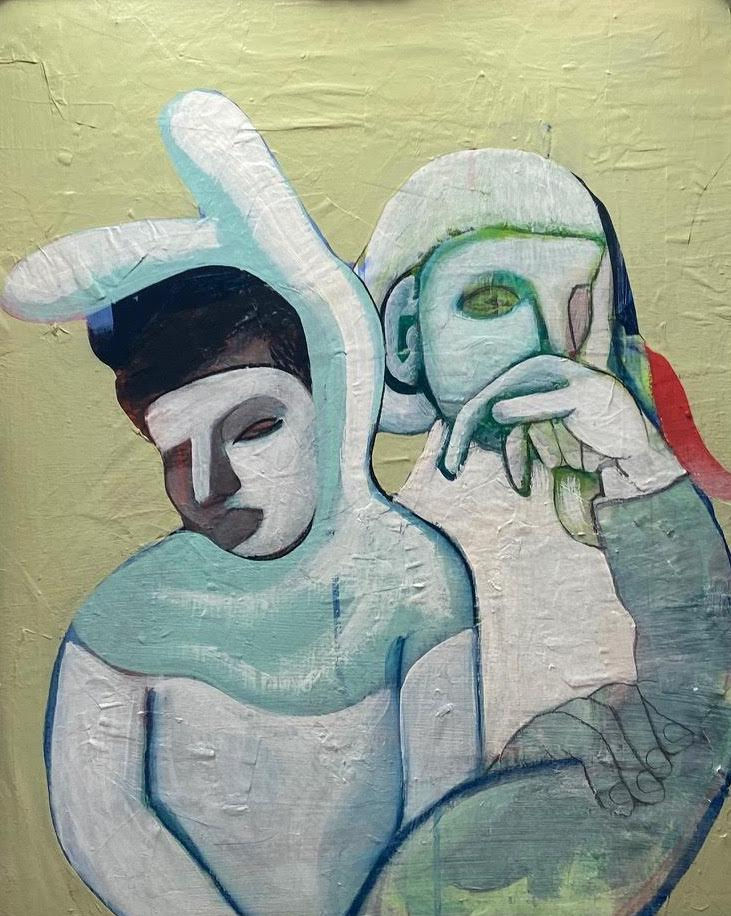
Leandro Comrie: “A Quiet Odyssey”
A major local artist lays out a Major Arcana of his own devising

What gives Leandro Comrie’s “King” the right to rule? Is it his raiment, decorated with scores of curlicues of white and royal purple paint, signifying motion and activity and cinched savagely at the waist? Is it his arms, long enough to touch his ankles, formidable and thick, draped at his sides in a gesture of ease and preternatural balance? How about the magenta halo behind his head, bright and electric, suggestive of sanctification in some other world? Or could it be the face, with its crown of wavy hair, full lips and slanted white eyebrows, and lower jaw squared against all adversaries. He looks confident and ready. But the crimson dot he stands on and surveys is barely big enough to contain his boat-like shoes.
His consort — the “Queen of Sighs,” as Comrie has named her — is similarly haloed. Hers, however, is the green of a croquet lawn at the height of spring. Tiny black and white flowers, like those that might be printed on an upmarket wedding illustration, hover in space before her breast. Her dress, which billows from the top of Comrie’s frame to the floor, is busy with the black sigils of a private alphabet. Behind her back, she conceals a red ball. She might be clutching it. Or she might be readying herself to throw it.

Ivy Huang, curator at IMUR (67 Greene St.), isn’t the sort to deny due privileges to visiting royalty. She’s mounted the two portraits, both large as a regal wardrobe, next to each other in the middle of the second floor gallery. On high, they preside over “A Quiet Odyssey,” a convention in nineteen pieces. No two invitees to Comrie’s garden party look alike, or address the viewer at the same angle or with the same intent, or conceal the same ulterior motive. Comrie’s “Odyssey” is a tangle of loaded glances from complicated lookers. Like any court worth its chronicle, this one hums with intrigue.
And the King and Queen aren’t as absolute as they seem. Comrie’s monarch is soulful and farsighted, but his feet are tightly circumscribed and his hands hang heavily at his sides. He has neither much latitude for action nor much of a domain. The belt around his waist is pulled so tight that his lower body is distorted. All that thoughtfulness and self-discipline isn’t helping him project or extend his power.
The Queen has impressive bearing, and presence, and a projectile, but she lacks the very thing that would allow her to articulate her royal wishes: a mouth. The script on her gown isn’t just cryptic — it’s overwashed with white paint. Comrie tilts the figure backward so it appears that we’re looking up at her, kneeling before her, awaiting a decree that will never come.
The rest of the people in the castle run schemes of their own. “The Juggler,” a sly figure with faded letters of his own on his jerkin, lets a pair of balls slip from his hands. He stands in front of the Tumba Muerto — the tomb of the dead — with the half-smile of the deflector, the entertainer charged with keeping the inevitable from haunting the minds of the members of his audience. Naturally, it’s impossible, and his absence of alarm at the tumbling spheres is his indication that he knows this very well.
Then there’s the monstrous, red-handed “Physician” who wears his tangled entrails on the outside of his body, wears a crown of angry scribbles, and faces the world with gritted teeth. The “Knight” stays impassive even as his blank-eyed face turns the ruddy color of a cooked lobster; the “Fool,” reclines bare-chested and likes his own photos on social media, and the “Lady in Waiting,” masked and slightly accusatory, shoots us a come-on glance as her body resolves to the quality of roiling smog.

All these characters are humbled by their limitations. The regent is constrained. The queen cannot speak. The juggler misses his toss; the physician’s innards are disordered and exposed; the pale-faced “Jester” averts her eyes and shrinks from the viewer; the “Bouncer” turns out to be a stationary man clinging, as a child might, to a gigantic beach ball.
Much of this is quite funny, but there’s a dark undercurrent to Comrie’s humor. The artist, a Venezuelan-American who bravely works as a translator at a fraught time for international understanding, clearly frets about the ineffectuality of authority and the erosion of respect. His “Popular Bust” is like something out of the ouevre of Buttered Roll: a masked military man in epaulettes, snake-shapes on his uniform, literally unarmed and punchless (he’s got no limbs) and unable to affect the world that surrounds him. Comrie’s “King” isn’t far from that fate. Once a decaying hierarchy is swept away, what will take its place?
To tell these stories, Comrie leans on the portrait style and vivid traffic-light color palette that those who attend group shows at Mana Contemporary have come to know as his. Green means runaway growth and renewal, red is for trouble and danger, gaffer’s-tape black is for marking borders between main characters and those in supporting roles, and characters and the inanimate world. The hands, feet, and nails he depicts are still enormous, and contoured, and strangely relaxed, even when the scene is a vexed one. A simmering, expectant, compliant sexuality runs through these reclining bodies. Every face is distinctive and different, but they’re all Comrie-style, with heavy eyebrows, shadowed noses, and hair-helmets over narrow foreheads. If you’ve liked Comrie’s work before, you’ll certainly enjoy this journey through a haunted Tarot deck of his own design.

Repeating himself, though, he is not. In “A Quiet Odyssey,” the artist pushes himself to try things he hasn’t before. Many of these pieces incorporate textiles in clever ways — either as backdrops for paintings or as pieces of a broader collage. Comrie also affixes real buttons to the jacket of the “Juggler,” spikes his acrylic paint with glitter, shaves lines and phrases out of magazines, stitches directly into the canvas, and repurposes bits of old projects. “The Fool” leans back on a painted pegboard and clutches a fraying wand of polka-dotted fabric. The neck of “The Bouncer” contains loaded words pinched from a notebook. “The Lover,” ready for action under a tigerskin blanket that may be an actual tiger, sports an earring. He’s surrounded by a border of fluffy red tassels, loose and a little chintzy, like burlesque marquee lights framing his desire.

Sometimes the textiles speak directly to Leandro Comrie’s skill as an appraiser, and appreciator of decorative weirdness. He sets his green-faced “Mother of Temperance” afloat on a piece of floral fabric pulled taut over a wooden frame. The artist gives his subject a pair of pupils: two emerald-colored plastic gemstones. Comrie slips them into the corners of her eyes and directs her gaze upward, away from the viewer and toward some focal point in the heavens.
Her face is neither masked nor occluded by shadows. Instead, she’s as open as the blooms that surround her. Her ears are fleshy and wide, her nostrils flare, her hands hang open, not grasping at anything, but ready to sense her surroundings. She’s not a ruler, or an entertainer, or even a lover. Instead, she’s the personification of natural wisdom and the spirit of balance. Comrie gives her strong arms and legs, and she’ll need them. She’s going to have to be on her toes when the rest of the system falls.
(“A Quiet Odyssey” opens on Friday, September 6 at 6 p.m. Normal IMUR hours are Thursday and Friday from 3 p.m. until 7 p.m. and Saturday from 2 p.m. until 6 p.m.)