
“The 16th” & “Handle With Care”
Two looks at global fragility from opposite sides of the Pacific

No nation has seen an uglier side of the Atomic Age than Japan. Hiroshima and Nagasaki remain the only cities devastated by nuclear bombs. After surrendering to the splitters of the nucleus, the Japanese promised never to rearm until the bombers (us) gave the okay. Fidelity to that pledge didn’t save them from another atomic megadisaster: the core meltdown at the Fukushima Daiichi nuclear reactor in 2011. Fifteen years later the contamination — and humiliation — remains. If a Japanese person should decline to hear a lecture about the miracle of the split atom, it’s not hard to understand why.
Nevertheless, the country has not turned against nuclear power. Fifteen plants still operate in Japan, and the government has ambitious plans for more output. Many ecologists and urban planners argue that this is the clean and responsible thing to do.
Psychologists might want to complicate the picture. After Fukushima, the mere mention of a reactor is probably enough to prompt PTSD. In “The 16th Anti-Nuclear Power Art Exhibition,” a group of Japanese artists have taken over half of Eonta Space (47 DeKalb Ave.) for a multimedia exercise in pained ambivalence. Though the tone of the show is gentle, despair and suspicion of power structures run deep. The attitude of the “The 16th” is like that of a person who has been smacked once, and is waiting to get smacked again.
Provocateurs that they are, the Eonta gallerists have matched “The 16th” with a parallel show from a quintet of American artists. “Handle With Care” is subtitled “fragile materials for fragile times,” and the pieces on the east and south side of Eonta Space, made of thread, ceramic, mesh, and glass, do seem to shiver with apprehension. But they’re also expansive in a manner that the Japanese artworks simply aren’t. The “Handle” pieces take a different approach to indissoluble anxiety. Instead of retracting in the face of peril, they’re finding a perverse sort of refuge in their own exuberance. Deliberately or not, this double show makes a statement about the dispositional differences between a society braced for doom and a society that has already been so visited.

Some of the Japanese art is tender enough to coax a tear from an atomic cowboy. Chie Shimamura paints a tiny map of Japan on the side of a hollowed eggshell and suspends it in a nest of thick wire over a black marble cube. Then the sculptor drives a savage little red-headed stickpin into his homeland — right where Fukushima Daiichi meets the sea. The egg takes the pin-prick stoically, but it easily could have cracked in two, or slipped from its golden coil and shattered on a block the color of the void. In the “Space,” installation Mi Jong Kim distributes nine toy monkeys on the curved and slippery surface of a glass sphere. They look completely exposed: to the crowded conditions atop the ball, to the thin chain that suspends them in space, to the fearsome effects of entropy, and to each other. They have no choice but to cooperate. There’s nowhere to run.
Pieces that might seem ambiguous in another context are, in a show meant to commemorate a tragedy, subtly scalding. Tohoka Matsuda’s pleading “The Prayer,” a woodcut on Japanese rice paper, shows a pair of open hands against a black sky dotted with white particles. The character whose splayed digits fill the center of the frame is trying to catch something, but the thickness of the printed lines and the unevenness of the fingers conveys the weariness of too-long days in too-long years. Are the circles descending toward his palms snowflakes, or stars, or fallout? Regardless, these hands seem overwhelmed by that which they are about to receive.

All of these works (and others in “The 16th”) feel like engagements with the law of gravity and desperate negotiations with the sky. Things are inevitably falling; if we don’t watch ourselves, we may be the next to tumble. Five objects rendered in acrylic seem to come apart against a sea of blue, smoke from cooling towers hangs dangerously low over a working-class town, a spiral of origami cranes bear the flag designs of nations in the so-called nuclear club. “Keep uranium in the ground,” we’re told in a grave photo essay by Yasuyo Tanaka, as if by elevating something chthonian, we're messing with the natural order of things. Reprisals will surely follow.
The artists in "Handle With Care" aren't quite so gunshy about mixing matters. They, too, work with fissile substances, but in their pieces, nothing has shattered yet. Eonta founder and gallerist Dan Peyton shows some of his most elaborate stained glass lightboxes, including one with red panels as rich in hue as cardinal's feathers. Adding scores of tiny panels might increase the breakable surface area, but Peyton cuts it up anyway, just as his Eonta partner Bayard stretches out a thinly woven canopy of multicolored fiber and risks it fraying. Sure, you could get tangled in this artwork. Eonta Space wants you to inhabit it anyway.
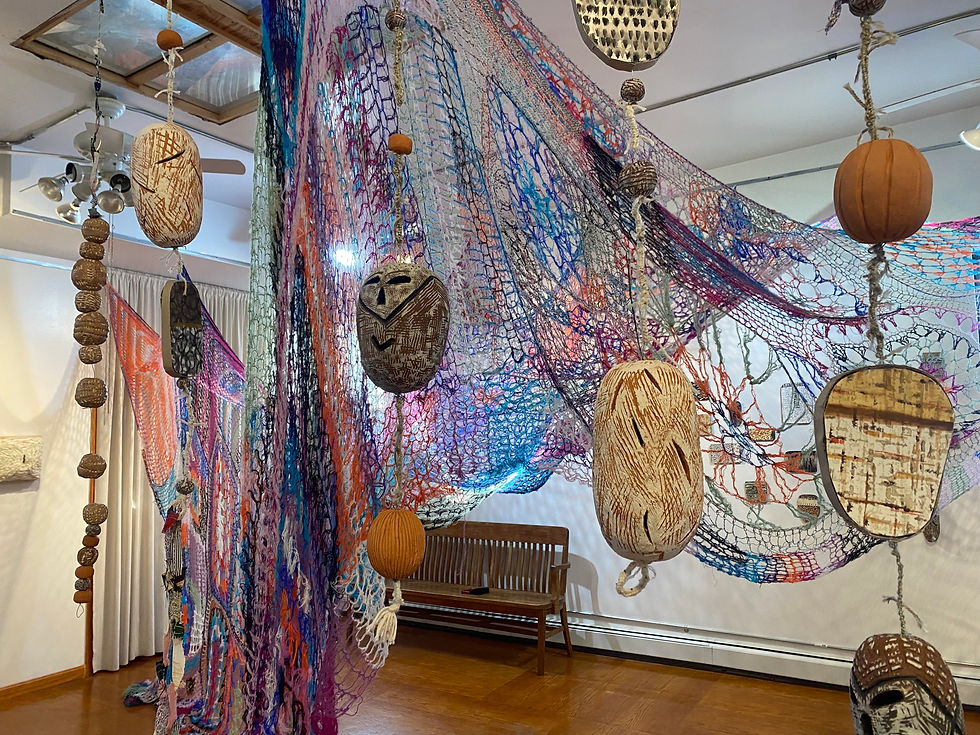
Megan Klim, fashioner of wall sculptures that simultaneously suggest medical equipment, mystery machinery, barnacles on boat hulls, and the female anatomy, brings us a passel of new pieces that look ready to burst. Gretchen Van Dyk contributes large ceramic shakers, big as gourds and dangling on hand-tied ropes. They rattle when they're perturbed, and that perturbation is part of the art. The sculptor expects agitation.
Then there’s Ashi Diamon, a scene-setter in miniature, who invites us to explore her meticulously rendered dollhouse dioramas. Even when she’s showing us a bar that time forgot, she’s careful to draw our eyes to a little blue ashtray on a tiny counter filled with half-lit cigarettes that emit silver filament-smoke. Those thin wires return in a piece that’s even better: a grill no larger than a matchbook on a dais the size of a thick hockey puck. The fibers that burst from the back of the lid portend trouble for the roast, and maybe for the entire neighborhood. The cautious Diamon has encased the entire thing in a capsule of glass, but there’s a real sense that this conflagration is getting out of control.

For now, the block is still standing. A disaster might be on the horizon, but Diamon’s invisible characters haven’t yet felt the flame. No matter how much apprehension they’ve got or how fragile they know they are, an aura of invincibility still surrounds them. The artists of “The 16th” are in a different position: they’re already familiar with disaster, and they don’t much like their chances of avoiding another cataclysm. Their entreaties to the fates are urgent ones. Today at 5 p.m., in commemoration of the East Japan earthquake and the disaster it engendered, Eonta Space will send up another prayer. We might set aside our American swagger for an evening, and drop to our knees on behalf of a well-armed and irradiated world in deep, deep trouble.


