
“She’s Like the Wind”
A reintroduction to the body, its impulses, its carnal demands, and its holy mysteries.

The first thing you’ll see upon entering the gallery at Deep Space (77 Cornelison St.) is the shadow-outline of a woman’s leg. There it is, on a chartreuse background, sticking straight up in the air with a curvaceous bare foot inches from the ceiling. That’s all of the subject of “Lemon Lime Toe of God” that the oil painter Delilah Ray Miske is willing to show us. The rest of the body, she implies, is splayed out on a bed. We know it’s summer because the window is closed and the air conditioner is plugged in. There’s a pretty good chance that the possessor of the leg is undressed. In one hand, she holds a cellphone, and she might be broadcasting something. On the wall, a small whip-like broomstick hangs. It could be the ride of a tiny witch. It could be the professional tool of a dominatrix.
Jersey City art shows are about many things. Sex is rarely one of them. On its surface, this is odd: we’re not a censorious place, nor are we afraid to tackle controversial subjects. We will speak truth to power without hesitation. Yet when it comes to matters carnal, we can be shy. It could be that our galleries are determined to keep things family-friendly in order to open the doors to as wide an audience as possible. I reckon it’s more likely that our aversion to skin has more to do with our notorious self-effacement. Calling attention to our desires — in public, no less — is embarrassing. The reluctance to get erotic has even extended to the annual all-female show at Deep Space, a safety zone for free and weird expression if there ever was one. Not this year, though. “She’s Like the Wind,” named after a slow-burning, saxophone-spiked guilty pleasure by Patrick Swayze, is cautiously but unmistakably sexy.

Often, that caution is a performance, a misdirection, just enough to give plausible deniability to the artists. In Miske’s “Lemon Lime,” we’re never shown the woman in the flesh. As in all good flirtations, the body is both absent and present, shrouded, mysterious, teasing some greater revelation.
The intriguing Leigh Cunningham takes that further. Her oil paintings are meticulously rendered blurs. She shows us people as we might apprehend them through a translucent shower curtain. In “Sleeper,” we don’t see the woman’s eyes, and we can’t quite tell whether her repose is restful. Yet her posture feels expectant: top shoulder tipped forward a bit, hands folded and tucked under her chin, head forward in the frame as if she’s about to whisper something to us. “Here and There,” a room scene, comes on as a wash of muted color and illumination until it coheres into a painting of a lithe young woman in a chair. Her long legs are crossed, her dress is modest but cut short, and she’s barefoot. The soft light of a desk lamp in the corner caresses her face. The painting is a calibration of curves, a suggestion made beyond arm’s length, a hopeful wild guess.
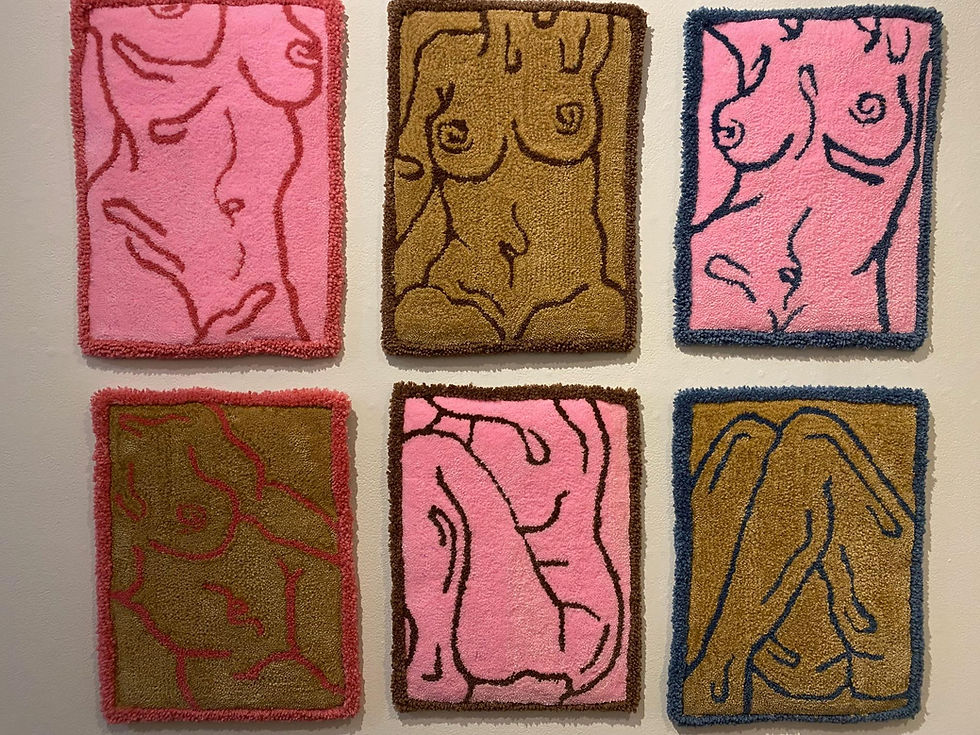
Steaming up the mirror is only one way to conceal the identity of a sexualized subject. There’s also the time-tested strategy of cropping the human body just below the neckline. SarahGrace, a textile artist who knows the tactile pleasures of tufted yarn, presents us headless female nudes in caramel brown, candy red, and hot pink. The breasts of her subjects are full and round, their long muscles of their legs are nicely defined, and each one is tickled with an affectionate curlicue in the vicinity of the bellybutton. All that’s missing are the faces. But aspirationally or otherwise, you can use your imagination to pop yours (or the face of someone you admire) atop these appealing torsos. Should you think SarahGrace is just innocently sewing together something appropriate for the bathroom, her titles make her intentions clear: “Provoke,” “Spike,” “Dominate,” etcetera. It’s spring. Action is on her mind.
Is she kidding a little? Naturally. But the ways in which she means it are more interesting and more exciting than the ways in which she doesn’t. That’s also always been true about the lively work of Amelia Shields, a painter whose work is simultaneously very funny and no joke at all. For “She’s Like the Wind,” Shields presents an approximation of passion or something resembling it: an older couple, captured in lush, melting aerosol, eyes closed and indulging in a kiss. In her “Liplock” series, the man smooches dutifully, but the woman has her head tipped so far back she’s practically upside-down. There’s something a little stiff and English about it, and that awkwardness is intentional — Shields is always a bit of a satirist — but it’s also clear that something rapturous is happening to these proper people, even if they don’t know it in the moment.

Get close to these pieces and you’re liable to warm up and maybe start to sizzle. Other artists hanging work on the wall nearby SarahGrace and Amelia Shields have dropped their reticence, joined the party, and posted some mash notes of their own. Painter Rebecca N. Johnson is well known for her images of winsome young women in states of nature, but much of the time, her characters are having a profound inner experience, cupped in the bells of flowers or nestled, faun-like, in forest groves. In “Dance to the Inner Lights” and “Dance Is Strong Magic,” Johnson’s flower ladies keep their eyes shut, but they’re otherwise on the move, bending their rubbery arms toward eye-popping posteriors. Deming King Harriman, creator of digital collage prints that have, in the past, felt as austere as a Victorian-era primer, shares an array of insects and flowers that hint at the delicate shape of female genitalia.
These are all steps in a positive direction. Sex is a part of existence; some of us might argue that it’s the very best part there is. Life is an erotic experience. “She’s Like the Wind” is the best rejoinder to the most trenchant critique of the art scene in Jersey City: that our collective faith in innocence, wonder, and magic is prepubescent. This year’s all-female show demonstrates that we can be gentle and grown-up at the same time. The ravages of the pandemic made bodies feel off-limits for awhile. Many of the best shows of 2024 and 2025 suggested that the physical world was back in all its sense-saturating sumptuousness. This is the first one I’ve seen that truly revels in the return.

The thaw, I think, began when the sculptor Shamona Stokes erected a giant fertility symbol outside the entrance of 150 Bay Street, one of the town’s most trafficked art spaces. Her modernized Venus of Willendorf was a reveille to those who were still snoozing through the reclamation of our humanity. Stokes, who can be quite no-nonsense when she wants to be, went as large as she ever has, and it’s hard not to think that she wasn’t trying to send a message to her peers about the indispensability of desire. In “She’s Like the Wind,” she returns to the miniature goddesses that she’s most comfortable with. In “Hearth and Home,” she designs a ceramic home for her menagerie of creations, each one placed inside an oval recess. These include a slender key, several eggs, a hungry-looking flower, and a perfect cream-white figurine of a deer. It is easy to imagine Stokes pressing these little shelters into the plaster with fingertips and thumbs, tucking in, making space.
That openness and penetrability is echoed all over this show. We see it in Gigi Chen’s “Still + Life,” an image of a bird on a branch with a glowing red breast between its dark wings and a glistening pomegranate — the true forbidden fruit of Eden — spilling its seeds at the bottom of the canvas. It’s there in Kaira Villanueva’s immersive landscapes, reminiscent of ‘50s and ‘60s pulp sci-fi book covers, and dotted with sinkholes, crevasses, melting spheres, and deep eyes of storms. It’s especially present in Cortney Herron’s “On Holiday at Midnight,” a come-on in black, brown, and wine-purple oil paint. The artist greets us with a bowl overflowing with fruit, a cup ready to be filled by the contents of a nearby bottle, and a central character whose dress is already far from her shoulders and halfway down her arms. She looks back at us with long, horizontal eyes under heavy black lids as if to say: your move.
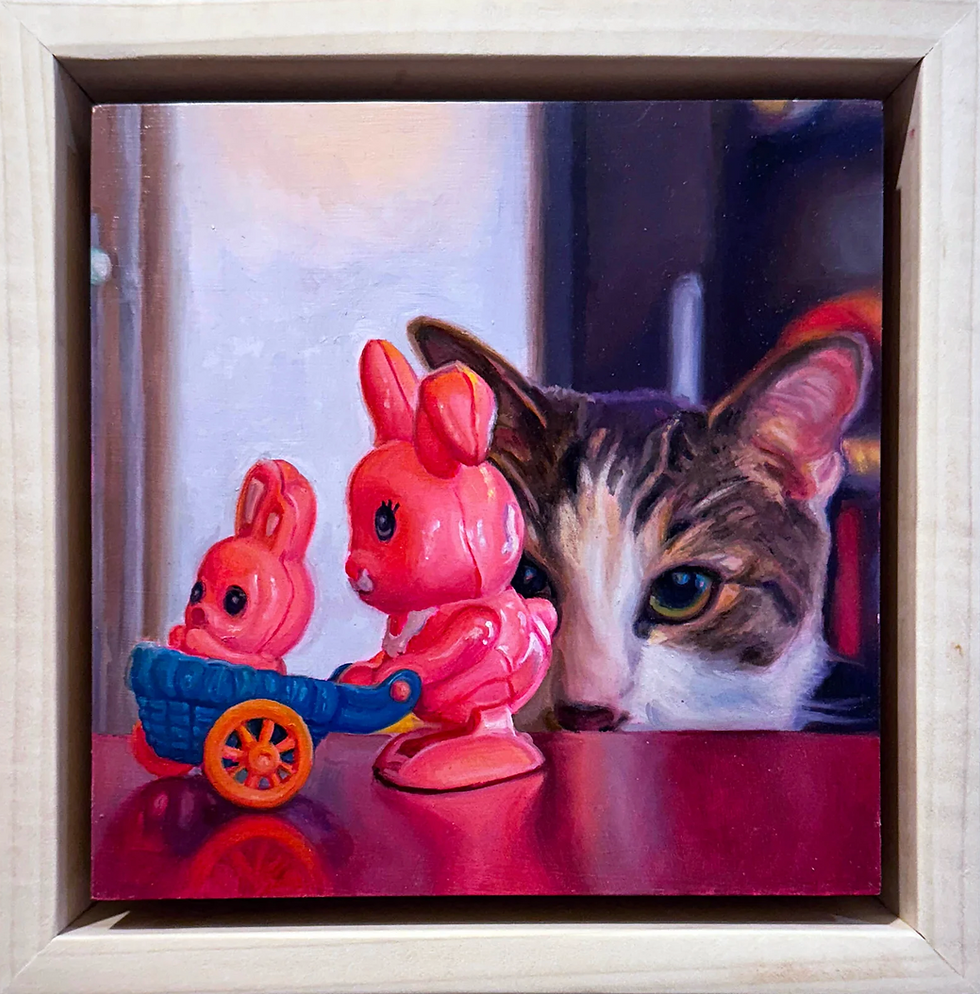
Herron’s protagonist is thoroughly human. There’s something feline about her too. Last year, Deep Space mounted an electrifying show about cats, so curators and gallerists Keith Van Pelt and Jenna Geiger certainly know their way around the scratching post. Cats, of course, have always served as proxies for female sexual desire: an artist who feels a little trepidation about getting her longing down on the canvas can always paint us a cat that channels some of her unruliness. The marvelously precise oil painter Jodi Gerbi contributes two images of a tabby possessed by her impulses. First, she’s attracted to a pair of pink plastic toys; before long, her paw is up and ready to swipe.
More explicit is the ever-clever Sherly Fan, who smothers one painting with images of candy hearts and delights and perturbs us with another in which flowers grow out of slits in the body of a stuffed lamb (“Bittersweet,” she calls it.) Her kitty is wrapped in a sash with a message for those who’d approach it: Leave Me Alone. The cat stares back at us with accusation in its green eyes. This painting, excellent in its conception and composition, is called “Come Play With Me!” We’ve still got our backs up. We’re still ambivalent about returning to the senses from which we’ve been alienated. But we’re getting there.
(“She’s Like the Wind” is open at Deep Space Gallery until May 17. There’ll certainly be opportunities to see this show before they take it down. You can always write to the gallery to see what’s up at deepspacejc@gmail.com.)


